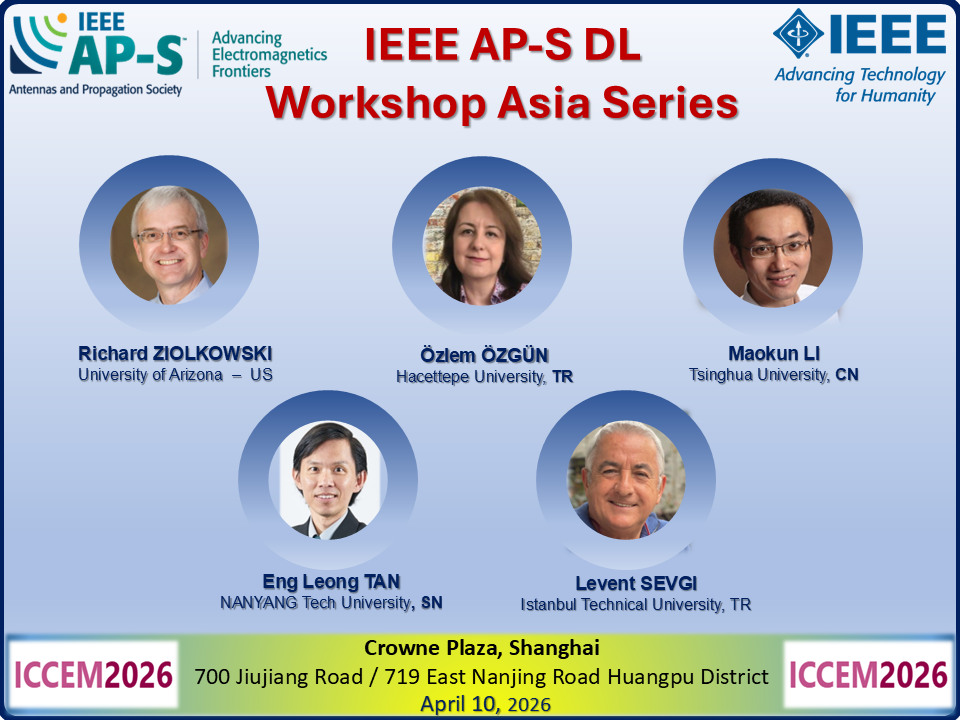
IEEE AP-S DL Workshop Asia Series

Prof. Richard W. Ziolkowski
Department of Electrical and Computer Engineering, The University of Arizona, Tucson, AZ 85721, USA
Email:
Speech Title
Electrically Small Antennas:
Advances in Efficiency, Bandwidth, and Directivity
Abstract
The introduction of metamaterials and metamaterial-inspired structures into the tool set of RF engineers has led to a wide variety of advances within research and application areas treating structures that radiate (e.g., RF antennas) and scatter (e.g., optical nano-antennas). The increased awareness of complex media, both naturally occurring and artificially constructed, which has been stimulated by the debut of metamaterials, has enabled paradigm shifts in terms of our understanding of how devices and systems operate and our expectations of their performance characteristics. These shifts include the trends of miniaturization, enhanced performance (total radiated power, bandwidth and directivity), reconfigurability and multifunctionality. New techniques have been developed that are truly beginning to impact practical realizations and their applications.
A variety of metamaterial-inspired, near-field resonant parasitic (NFRP), electrically small antennas have been developed that exhibit multifunctional performance, enhanced bandwidths, and higher directivities. Their engineering is achieved by combining multiple NFRP elements with simple driven radiators. Higher directivity is obtained by simultaneously exciting balanced electric and magnetic NFRP elements, leading, for example, to endfire and broadside radiating Huygens dipole antennas (HDAs). Enhanced bandwidths and loss mitigation, as well as wireless power transfer capabilities, have been achieved by augmenting the HDAs with non-Foster (active) and rectifying (rectenna) elements. A variety of HDAs and arrays of them have been fabricated and tested to confirm their attractive performance characteristics; they will be reviewed briefly.
Nonetheless, even more highly directive antenna systems are being sought to address the perceived needs of the NextG / XG wireless systems and their applications. Combinations of higher order multipole electric and magnetic radiating elements have been developed that achieve unidirectional performance with even higher directivities. Several of these unidirectional mixed-multipole antennas (MMAs) have been fabricated and tested to confirm their attractive properties. Uniform circular arrays of HDAs and their sector versions have also been developed and tested, confirming their enhanced directive performances. These advanced-concept systems will also be reviewed.
A variety of metamaterial-inspired, near-field resonant parasitic (NFRP), electrically small antennas have been developed that exhibit multifunctional performance, enhanced bandwidths, and higher directivities. Their engineering is achieved by combining multiple NFRP elements with simple driven radiators. Higher directivity is obtained by simultaneously exciting balanced electric and magnetic NFRP elements, leading, for example, to endfire and broadside radiating Huygens dipole antennas (HDAs). Enhanced bandwidths and loss mitigation, as well as wireless power transfer capabilities, have been achieved by augmenting the HDAs with non-Foster (active) and rectifying (rectenna) elements. A variety of HDAs and arrays of them have been fabricated and tested to confirm their attractive performance characteristics; they will be reviewed briefly.
Nonetheless, even more highly directive antenna systems are being sought to address the perceived needs of the NextG / XG wireless systems and their applications. Combinations of higher order multipole electric and magnetic radiating elements have been developed that achieve unidirectional performance with even higher directivities. Several of these unidirectional mixed-multipole antennas (MMAs) have been fabricated and tested to confirm their attractive properties. Uniform circular arrays of HDAs and their sector versions have also been developed and tested, confirming their enhanced directive performances. These advanced-concept systems will also be reviewed.
Biography
Richard W. Ziolkowski received the B.Sc. (magna cum laude) degree (Hons.) in physics from Brown University, Providence, RI, USA, in 1974; the M.S. and Ph.D. degrees in physics from the University of Illinois at Urbana-Champaign, Urbana, IL, USA, in 1975 and 1980, respectively; and an Honorary Doctorate degree from the Technical University of Denmark (DTU), Kongens Lyngby, Denmark in 2012.
He is currently a Professor Emeritus with the Department of Electrical and Computer Engineering at The University of Arizona, Tucson, AZ, USA. He was a Litton Industries John M. Leonis Distinguished Professor in the College of Engineering and was also a Professor in the College of Optical Sciences until his retirement in 2018. He was also a Distinguished Professor in the Global Big Data Technologies Centre in the Faculty of Engineering and Information Technologies (FEIT) at the University of Technology Sydney, Ultimo NSW Australia from 2016 until 2023. He was the Computational Electronics and Electromagnetics Thrust Area Leader with the Engineering Research Division of the Lawrence Livermore National Laboratory before joining The University of Arizona in 1990.
Prof. Ziolkowski was the recipient of the 2019 IEEE Electromagnetics Award (IEEE Technical Field Award). He is an IEEE Life Fellow, as well as a Fellow of OPTICA (previously the Optical Society of America, OSA) and the American Physical Society (APS). He was the 2014-2015 Fulbright Distinguished Chair in Advanced Science and Technology (sponsored by DSTO, the Australian Defence Science and Technology Organisation). He served as the President of the IEEE Antennas and Propagation Society (AP-S) in 2005 and has had many other AP-S leadership roles. He is also actively involved with the URSI (International Union of Radio Science) Commission B and the European Association on Antennas and Propagation (EurAAP). He is the co-Editor of the best-selling 2006 IEEE-Wiley book, Metamaterials: Physics and Engineering Explorations, as well as the co-author and co-Editor, respectively, of the recent Wiley-IEEE books: Advanced Antenna Array Engineering for 6G and Beyond Wireless Communications (2022) and Antenna and Array Technologies for Future Wireless Ecosystems (2022).
He is currently a Professor Emeritus with the Department of Electrical and Computer Engineering at The University of Arizona, Tucson, AZ, USA. He was a Litton Industries John M. Leonis Distinguished Professor in the College of Engineering and was also a Professor in the College of Optical Sciences until his retirement in 2018. He was also a Distinguished Professor in the Global Big Data Technologies Centre in the Faculty of Engineering and Information Technologies (FEIT) at the University of Technology Sydney, Ultimo NSW Australia from 2016 until 2023. He was the Computational Electronics and Electromagnetics Thrust Area Leader with the Engineering Research Division of the Lawrence Livermore National Laboratory before joining The University of Arizona in 1990.
Prof. Ziolkowski was the recipient of the 2019 IEEE Electromagnetics Award (IEEE Technical Field Award). He is an IEEE Life Fellow, as well as a Fellow of OPTICA (previously the Optical Society of America, OSA) and the American Physical Society (APS). He was the 2014-2015 Fulbright Distinguished Chair in Advanced Science and Technology (sponsored by DSTO, the Australian Defence Science and Technology Organisation). He served as the President of the IEEE Antennas and Propagation Society (AP-S) in 2005 and has had many other AP-S leadership roles. He is also actively involved with the URSI (International Union of Radio Science) Commission B and the European Association on Antennas and Propagation (EurAAP). He is the co-Editor of the best-selling 2006 IEEE-Wiley book, Metamaterials: Physics and Engineering Explorations, as well as the co-author and co-Editor, respectively, of the recent Wiley-IEEE books: Advanced Antenna Array Engineering for 6G and Beyond Wireless Communications (2022) and Antenna and Array Technologies for Future Wireless Ecosystems (2022).
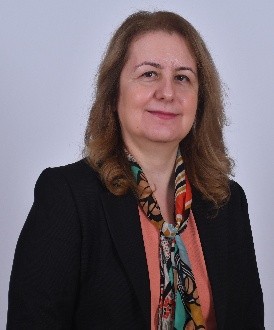
Prof. Özlem ÖZGÜN
Department of Electrical and Electronics Engineering
Vice Dean, Faculty of Engineering
Hacettepe University, Ankara, TURKEY
IEEE AP-S Distinguished Lecturer (DL) (2025-2027)
Email:
Speech Title
Advanced Computational Electromagnetics: Beyond the Standard Numerical Modeling Techniques
Abstract
Computational Electromagnetics (CEM) is an interdisciplinary field that combines principles from electrical engineering, physics, mathematics, and computer science to simulate and analyze electromagnetic phenomena. It serves as a cornerstone for the design and optimization of practical systems such as antennas, microwave circuits, radars, satellites, wireless communication devices, and emerging applications in nanophotonics and biomedical imaging. The increasing complexity of modern systems—featuring irregular geometries, inhomogeneous media, and multiscale behaviors—necessitates robust and efficient modeling and simulation techniques.
Over the past decades, CEM has evolved to address challenges associated with electrically large structures, multiphysics environments, and high-frequency regimes. Recent advancements in computing technologies—especially GPUs and domain-specific hardware—have enabled researchers to solve problems with billions of unknowns, while hybrid numerical schemes and parallel implementations ensure scalability and efficiency. Recent trends also include the use of machine learning-based surrogate models, which are trained to approximate the behavior of computationally expensive simulations, enabling faster predictions without compromising accuracy.
This lecture will present advanced techniques used to tackle contemporary challenges in CEM, such as hybrid methods, domain decomposition, and large-scale parallel solvers. Current trends that are reshaping the future of the field—such as the integration of data-driven machine learning approaches into electromagnetic modeling workflows—will be briefly highlighted. Real-world case studies will be presented to illustrate the practical applications of these methods in the simulation of electromagnetic radiation and scattering problems.
Over the past decades, CEM has evolved to address challenges associated with electrically large structures, multiphysics environments, and high-frequency regimes. Recent advancements in computing technologies—especially GPUs and domain-specific hardware—have enabled researchers to solve problems with billions of unknowns, while hybrid numerical schemes and parallel implementations ensure scalability and efficiency. Recent trends also include the use of machine learning-based surrogate models, which are trained to approximate the behavior of computationally expensive simulations, enabling faster predictions without compromising accuracy.
This lecture will present advanced techniques used to tackle contemporary challenges in CEM, such as hybrid methods, domain decomposition, and large-scale parallel solvers. Current trends that are reshaping the future of the field—such as the integration of data-driven machine learning approaches into electromagnetic modeling workflows—will be briefly highlighted. Real-world case studies will be presented to illustrate the practical applications of these methods in the simulation of electromagnetic radiation and scattering problems.
Biography
Özlem Özgün is currently a full professor in the Department of Electrical and Electronics Engineering and vice dean of the Faculty of Engineering at Hacettepe University, Ankara, Turkey. She received her B.Sc. and M.Sc. degrees from Bilkent University and her Ph.D. from Middle East Technical University (METU), all in Electrical and Electronics Engineering. She was a postdoctoral researcher at Penn State University, US.
Her research interests include various topics in computational electromagnetics and radiowave propagation, including electromagnetic radiation and scattering, numerical methods, domain decomposition methods, transformation electromagnetics, stochastic electromagnetic problems and optimization techniques. She has authored over 130 refereed publications in international journals, book (MATLAB-based Finite Element Programming in Electromagnetic Modeling, CRC Press, 2018), book chapters and conference proceedings.
Dr. Özgün is a senior member of IEEE and URSI and a past chair of the URSI Turkey steering committee. Her awards include the METU Best Ph.D. Thesis Award (2007), the Felsen Fund Excellence in Electromagnetics Award (2009), and Hacettepe University Science Award (2024). She was recognized among the world's top 2% most influential scientists (Stanford University & Elsevier, 2023–2025).
Her research interests include various topics in computational electromagnetics and radiowave propagation, including electromagnetic radiation and scattering, numerical methods, domain decomposition methods, transformation electromagnetics, stochastic electromagnetic problems and optimization techniques. She has authored over 130 refereed publications in international journals, book (MATLAB-based Finite Element Programming in Electromagnetic Modeling, CRC Press, 2018), book chapters and conference proceedings.
Dr. Özgün is a senior member of IEEE and URSI and a past chair of the URSI Turkey steering committee. Her awards include the METU Best Ph.D. Thesis Award (2007), the Felsen Fund Excellence in Electromagnetics Award (2009), and Hacettepe University Science Award (2024). She was recognized among the world's top 2% most influential scientists (Stanford University & Elsevier, 2023–2025).

Prof. Maokun Li
Tsinghua University, China
Speech Title
Electromagnetic Sensing and Imaging (for general audience)
Abstract
It is well known that electromagnetic waves can penetrate many kinds of materials. When illuminated by electromagnetic waves, different materials will respond differently. Therefore, electromagnetic physics provides us with an essential tool for sensing and imaging. We can infer the properties of the targets under investigation from the measured electromagnetic signal. Electromagnetic sensing has been applied to hydrocarbon production, land mine detection, and many other areas since the 1920s. However, due to the limit in computing power, researchers can only interpret the domain of investigation by directly browsing the recorded signal. Reasonable interpretation requires ample experience, but it is still hard to be accurate enough. In the 1970s, computers were used in data processing, and algorithms were developed to estimate the electromagnetic properties of the investigation domain from the recorded survey data. During this time, inversion algorithms could only reconstruct simple one-dimensional models with tens of unknowns using linear approximations. It still took a long time to compute. These days, nonlinear inversion algorithms can reconstruct three-dimensional models with millions of unknowns on high-performance computing platforms. Many new electromagnetic sensing methods were developed alongside these developments, such as the widely used marine-controlled-source electromagnetic surveys for hydrocarbon exploration and breast cancer detection using microwaves. With the help of new sensors, big data technology, massive parallelization, and fast algorithms, electromagnetic sensing and imaging have become more effective and gained more applications.
In this talk, the presenter would like to discuss the fundamentals of electromagnetic sensing and imaging, solutions to electromagnetic inverse problems, and many practical examples from hydrocarbon exploration, radar imaging, biomedical diagnosis, and non-destructive testing. The presenter will discuss the challenges and new research directions for future electromagnetic sensing and imaging.
In this talk, the presenter would like to discuss the fundamentals of electromagnetic sensing and imaging, solutions to electromagnetic inverse problems, and many practical examples from hydrocarbon exploration, radar imaging, biomedical diagnosis, and non-destructive testing. The presenter will discuss the challenges and new research directions for future electromagnetic sensing and imaging.
Biography
Maokun Li (M04, S21, F25) received the B.S. degree in electronic engineering from Tsinghua University, Beijing, China, in 2002, and the M.S. and Ph.D. degrees in electrical engineering from the University of Illinois at Urbana-Champaign, Champaign, IL, USA, in 2004 and 2007, respectively. He then worked as a Senior Research Scientist at Schlumberger-Doll Research in Cambridge, MA, USA. In 2014, he joined the Department of Electronic Engineering, Tsinghua University, Beijing. He is currently a professor at the Microwave and Antenna Institute. His interests are in electromagnetic theory and computational electromagnetics, especially in fast, reliable modeling and inversion algorithms for EM wave propagation in complex environments, with applications in geophysical exploration, biomedical imaging, etc. He is an associate editor of the IEEE Transactions on Antennas and Propagation, the IEEE Transactions on Geoscience and Remote Sensing, and the IEEE Journal on Multiscale and Multiphysics Computational Techniques. He is also a member of the AP-S membership and benefits committee and serves as the IEEE AP-S Distinguished Lecturer (2023-2025). He received the 2017 IEEE Ulrich L. Rohde Innovative Conference Paper Award, the 2019 PIERS Young Scientist Award, and the 2021 Instructor Award for Excellent Ph.D. Thesis by the China Education Society of Electronics. He was elected as a Fellow of the Applied Computational Electromagnetics Society (ACES) in 2022 and a Fellow of IEEE in 2025.

Prof. Eng Leong Tan
Nanyang Technological University, Singapore
Speech Title
Explicit, Implicit and Fundamental Schemes for FDTD Methods in Electromagnetics Computation and Education
Abstract
In this talk, some explicit, implicit and fundamental schemes for finite-difference time-domain (FDTD) methods in electromagnetics (EM) computation and education are presented. A brief introduction is first given to the popular explicit finite-difference time-domain (FDTD) scheme, which is subjected to Courant-Friedrichs-Lewy (CFL) stability condition. This is followed by the development of various implicit FDTD schemes, which are unconditionally stable FDTD methods without the constraint of CFL time-step size. These methods include alternating direction implicit (ADI) FDTD, locally one-dimensional (LOD) FDTD, split-step (SS) FDTD, Crank-Nicolson direct splitting (CNDS), leapfrog ADI/LOD, complying-divergence implicit (CDI) FDTD, etc. They are discussed in the context of matrix exponential and classical implicit schemes named after Peaceman-Rachford, Douglas-Gunn, D’Yakonov, Strang, Crank-Nicolson, etc. It is noted that many classical and recent implicit methods can be transformed and unified under the same family of fundamental schemes. Such family of schemes feature similar update procedures with concise matrix-operator-free right-hand sides involving only vector operations. Since vector operations are much less expensive than matrix ones, the fundamental schemes are simpler and more efficient than many previous implicit FDTD methods of similar accuracy. A comparative study of various unconditionally stable FDTD methods is carried out, which includes comparisons of their update equations and efficiency gains (flops reduction) along with insights into their inter-relations. Extension of FDTD method is also presented based on new quantities of field-impulses that replace fields and potentials/gauge. If time permits, efficient fundamental schemes of implicit FDTD methods are demonstrated on mobile devices for enhanced EM teaching and learning with real-time simulations anytime, anywhere.
Biography
Eng Leong Tan (SM’06) received the B.Eng. (Electrical) degree with first class honors from the University of Malaya, Malaysia, and the Ph.D. degree in Electrical Engineering from Nanyang Technological University (NTU), Singapore. From 1999 to 2002, he was with Institute for Infocomm Research, Singapore and since 2002, he has been with the School of Electrical & Electronic Engineering, NTU. His research interests include computational electromagnetics (CEM), multi-physics (including quantum, acoustics, thermal), RF/microwave circuit and antenna design. He has published more than 150 journal papers and presented more than 100 conference papers. He and his students received numerous paper and project awards/prizes including: 2019 Ulrich L. Rohde Innovative Conference Paper Award on Computational Techniques in Electromagnetics, First Prize in 2014 IEEE Region 10 Student Paper Contest, First Prize in 2014 IEEE MTT-S Student Design Contest on Apps for Microwave Theory and Techniques, First Prize in 2013 IEEE AP-S Antenna Design Contest, etc. He was the recipient of the IEEE AP-S Donald G. Dudley Jr. Undergraduate Teaching Award with citation: “For excellence in teaching, student mentoring, and the development of mobile technologies and computational methods for electromagnetics education.” He has been actively involved in organizing many conferences and workshops, including General Chair of PIERS 2017 Singapore, TPC Chair of ICCEM 2020, APCAP 2018 (Auckland) and 2015 (Bali), as well as TPC Chair of IEEE APS/URSI 2021. He is a Fellow of ASEAN Academy of Engineering and Technology, and a Fellow* of the Electromagnetics Academy in recognition of distinguished contributions to “Computational electromagnetics and education”. He has been appointed as the IEEE AP-S Distinguished Lecturer for 2025-2027 and MTT-S Speaker under TC-1 Field Theory and Computational EM Committee Speakers Bureau.

Prof. Levent Sevgi
ITU - Istanbul Technical University (Emeritus)
IEEE AP-S Former DL – DLPC Chair
Email:
Speech Title
Antennas, Arrays & Calibration: Beam Forming and Beam Steering
Abstract
Antenna is an electromagnetic (EM) radiator that emits radio frequency power. It is a transducer that converts voltage [V] to the electric field [V/m] (or vice versa). This IEEE AP-S DL talk will focus on EM radiators, antennas, antenna arrays and calibration. First, circuit and EM models of an antenna will be reviewed. Fundamental antenna terms and concepts will be summarized. Then, differences between communication and EMC antennas will be given. Finally, the antenna calibration will be explained. In the second part, formation of antenna arrays will be presented, and their beam forming and beam steering capabilities will be shown via a simple, MATLAB-based ARRAY virtual tool. Any 2D array (i.e., linear, planar, circular, etc.) may be designed by the user and its 2D and 3D radiation characteristics can be investigated using this tool. Beam forming capabilities for different locations, number of radiators, as well as for operating frequencies can be visualized. The package may be used as an educational tool in many undergraduate antenna lectures. It may also be used to validate and verify the finite-difference time-domain (FDTD) and method of moments (MoM) packages in public domain, or, for example, the ones supplied in [3]. Moreover, the user may improve package and add novel features by using the supplied source codes.
Biography
Prof. Dr. Levent Sevgi is a Fellow of the IEEE (since 2009) and the recipient of IEEE APS Chen-To Tai Distinguished Educator Award (2021). He was with Istanbul Technical University (1991–1998), TUBITAK-MRC, Information Technologies Research Institute (1999–2000), Weber Research Institute / NY Polytechnic University (1988–1990), Scientific Research Group of Raytheon Systems Canada (1998 – 1999), Center for Defense Studies, ITUV-SAM (1993 –1998 and 2000–2002) and with University of Massachusetts, Lowell (UML) MA/USA as a full-time faculty (2012 – 2013), DOGUS University (2001-2014), Istanbul OKAN (2014 - 2021), and ATLAS (2022-2024) Universities.
He served four years (2020-2023) as an IEEE AP-S Distinguished Lecturer. Since Jan 2024 he has been the chair of the IEEE AP-S DL Committee. He served one-term in the IEEE AP-S AdCom (2013-2015) and one-term and as a member of IEEE AP-S Field Award Committee (2018-2019). He had been the writer/editor of the “Testing ourselves” Column in the IEEE AP Magazine (2007-2021), a member of the IEEE AP-S Education Committee (2006-2021), He also served in several editorial boards (EB) of other prestigious journals / magazines, such as the IEEE AP Magazine (2007-2021), Wiley’s International Journal of RFMiCAE (2002-2018), and the IEEE Access (2017-2019 and 2020 - 2022). He is the founding chair of the EMC TURKIYE Conferences (www.emcturkiye.org).
He has been involved with complex electromagnetic problems for nearly four decades. His research study has focused on electromagnetic radiation, propagation, scattering and diffraction; RCS prediction and reduction; EMC/EMI modelling, simulation, tests and measurements; multi-sensor integrated wide area surveillance systems; surface wave HF radars; analytical and numerical methods in electromagnetics; FDTD, TLM, FEM, SSPE, and MoM techniques and their applications; bio-electromagnetics. He is also interested in novel approaches in engineering education, teaching electromagnetics via virtual tools. He also teaches popular science lectures such as Science, Technology and Society.
He has published many books / book chapters in English and Turkish, over 180 journal/magazine papers / tutorials and attended more than 100 international conferences / symposiums. His three books Complex Electromagnetic Problems and Numerical Simulation Approaches, Electromagnetic Modeling and Simulation and Radiowave Propagation and Parabolic Equation Modeling were published by the IEEE Press - WILEY in 2003, 2014, and 2017, respectively. His fourth and fifth books, A Practical Guide to EMC Engineering (Sep 2017) and Diffraction Modeling and Simulation with MATLAB (Feb 2021) were published by ARTECH HOUSE.
His h-index is 39, with a record of 5300+ citations (source: Google Scholar, Nov 2025).
He served four years (2020-2023) as an IEEE AP-S Distinguished Lecturer. Since Jan 2024 he has been the chair of the IEEE AP-S DL Committee. He served one-term in the IEEE AP-S AdCom (2013-2015) and one-term and as a member of IEEE AP-S Field Award Committee (2018-2019). He had been the writer/editor of the “Testing ourselves” Column in the IEEE AP Magazine (2007-2021), a member of the IEEE AP-S Education Committee (2006-2021), He also served in several editorial boards (EB) of other prestigious journals / magazines, such as the IEEE AP Magazine (2007-2021), Wiley’s International Journal of RFMiCAE (2002-2018), and the IEEE Access (2017-2019 and 2020 - 2022). He is the founding chair of the EMC TURKIYE Conferences (www.emcturkiye.org).
He has been involved with complex electromagnetic problems for nearly four decades. His research study has focused on electromagnetic radiation, propagation, scattering and diffraction; RCS prediction and reduction; EMC/EMI modelling, simulation, tests and measurements; multi-sensor integrated wide area surveillance systems; surface wave HF radars; analytical and numerical methods in electromagnetics; FDTD, TLM, FEM, SSPE, and MoM techniques and their applications; bio-electromagnetics. He is also interested in novel approaches in engineering education, teaching electromagnetics via virtual tools. He also teaches popular science lectures such as Science, Technology and Society.
He has published many books / book chapters in English and Turkish, over 180 journal/magazine papers / tutorials and attended more than 100 international conferences / symposiums. His three books Complex Electromagnetic Problems and Numerical Simulation Approaches, Electromagnetic Modeling and Simulation and Radiowave Propagation and Parabolic Equation Modeling were published by the IEEE Press - WILEY in 2003, 2014, and 2017, respectively. His fourth and fifth books, A Practical Guide to EMC Engineering (Sep 2017) and Diffraction Modeling and Simulation with MATLAB (Feb 2021) were published by ARTECH HOUSE.
His h-index is 39, with a record of 5300+ citations (source: Google Scholar, Nov 2025).